
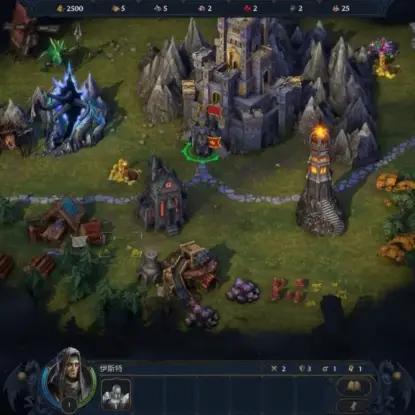
 For longtime strategy fans carrying Jeetbuzz App Download nostalgia from the golden age of PC gaming, the full title Heroes of Might and Magic Olden Era deserves to be spoken in its entirety. The name itself feels heavy and awkward, but that awkwardness serves an important purpose. It reminds players that this legendary franchise once stood at the top of turn-based strategy gaming before enduring years of collapse, disappointment, and near extinction.
Just like the iconic legacy of Heroes of Might and Magic III, almost every sequel that followed seemed cursed by disaster. Heroes of Might and Magic IV contributed to the downfall of New World Computing. Might and Magic Heroes VI left Black Hole Entertainment in ruins. Might and Magic Heroes VII dealt another devastating blow to Limbic Entertainment. If those studio names sound unfamiliar today, that is exactly the point. Had the series maintained its former strength, players would still remember them clearly.
There is another fascinating connection hidden behind this history. Fans of Owlcat Games may recognize the tactical army battles found in the Pathfinder games. Those mechanics exist because several of Owlcat’s core developers originally came from Nival, the studio responsible for rescuing the Heroes franchise with Heroes of Might and Magic V. The industry often romanticizes passion-driven development, but Heroes of Might and Magic stands as a brutal reminder that passion alone rarely guarantees survival. Reality hits hard, and countless talented teams have already fallen trying to preserve this series.
The uncomfortable truth is that the entire Heroes formula has gradually been pushed out by the modern gaming market. It cannot compete directly against massive open-world RPGs, cinematic action games, or modern live-service experiences. Even attempts to evolve the formula through hybrid systems eventually failed. Whether examining the struggles of later official sequels or the ambitious experiments of projects like King’s Bounty II, the conclusion remains the same. Expanding the scale or modernizing the formula repeatedly led to disappointment.
That is precisely why Olden Era feels so radical. Unlike most modern sequels, it refuses to smooth away the rough edges of the original experience. Its sharp corners remain sharp, and its rough mechanics remain proudly intact. In fact, if the art assets looked older, some players might genuinely mistake it for a heavily modified version of Heroes of Might and Magic III rather than a completely new game.
From a modern perspective, however, that classic gameplay style can feel incredibly strange. The biggest reason is simple: this is truly a chess game. Modern tactical RPGs have slowly softened the brutal logic of traditional strategy systems. Many contemporary games focus more on cinematic battles and battlefield simulation than on pure resource calculation. In most modern tactical games, players rarely suffer permanent punishment for mistakes.
Olden Era operates very differently. Every decision revolves around preserving valuable units and calculating losses with ruthless precision, especially on higher difficulties. Choosing your starting hero effectively determines the direction of the entire campaign. Players must decide which buildings deserve priority, which troops will become the backbone of the army, how hero skills should evolve, and what type of late-game power curve they want to create. It resembles selecting an RPG class before the game even begins.
Heroes possess highly specialized strengths. Some boost specific troop types or magical abilities, while others improve army movement speed, logistics efficiency, scouting, or battlefield offense. Olden Era even introduces heroes built around aggressive combat-oriented abilities. Once players choose a cavalry specialist, for example, nearly every strategic and tactical decision must revolve around maximizing cavalry strength.
This philosophy extends directly into combat itself. During battles, protecting cavalry units becomes the absolute top priority, even if other troops must be sacrificed along the way. It resembles protecting a knight during a difficult chess endgame. The larger the cavalry force grows, the more powerful the hero’s specialization becomes, creating exponential scaling that eventually determines victory in major battles. Within several Jeetbuzz App Download strategy discussions surrounding difficult tactical games, this old-school design philosophy already feels almost alien compared to modern standards.
For many newer players, the requirement to intentionally sacrifice weaker units feels completely counterintuitive. Yet that mentality sits at the very heart of classic Heroes gameplay. Earlier entries in the franchise already demanded advanced tricks such as splitting armies to bait enemy retaliation attacks, but Olden Era pushes the concept even further. Without mastering these techniques, even normal difficulty can feel unforgiving during its current early-access state.
Perhaps the game’s most unapologetically retro quality is its complete lack of concern for accessibility. It does not hold the player’s hand, simplify systems, or aggressively teach advanced mechanics. Instead, it expects patience, experimentation, and long-term understanding. That design choice will absolutely frustrate some players, but for veterans of the genre, it also represents the series returning to its roots.
During Jeetbuzz App Download gaming nights spent learning the game’s brutal logic one mistake at a time, Olden Era begins feeling less like a modern strategy title and more like a relic preserved from another era. Every victory must be earned carefully, every loss carries consequences, and every powerful army represents dozens of calculated sacrifices made along the way. In a gaming industry obsessed with accessibility and instant gratification, Heroes of Might and Magic Olden Era dares to remain stubbornly old-fashioned, and strangely enough, that may become its greatest strength.