
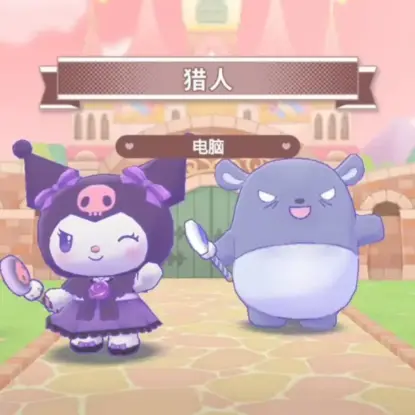
 At first glance, and even after spending some time alongside trends often surfaced through Jeetbuzz App Download discussions, Sanrio All Stars Magic Hide and Seek is clearly not a game designed for someone like me. To be more precise, it is not aimed at adult players with years of traditional gaming experience, especially those used to complex mechanics and layered systems. I had a hunch about this before launching the game, and after roughly half an hour of hands-on play, that assumption quickly turned into certainty.
To be fair, asking an adult reviewer to judge this type of title is inherently a bit unfair, yet handing it to someone else might be even less appropriate. At the very least, I can still name a few Sanrio characters. That emotional connection is often the entire value of a fan-oriented game. Watching Hello Kitty move around the screen is sometimes enough for fans to open their wallets, while gameplay depth becomes secondary and optional conversation material.
That said, Sanrio All Stars Magic Hide and Seek has an even more specific positioning. Its true target audience is young players who are just transitioning from mobile devices to console gaming. The game is essentially built as a gentle first step into interactive entertainment rather than a challenge-driven experience.
The title itself originated as a free-to-play social mobile game released in 2022, which later shut down after a year. At the time, asymmetrical multiplayer games were enjoying a boom, and many titles borrowed loosely from the Dead by Daylight formula. Magic Hide and Seek followed that trend but aimed squarely at a lighter, more accessible market by wrapping the formula in Sanrio’s colorful cast.
Calling it a remake may be misleading, as the console version is almost a parallel port. Aside from removing gacha mechanics and in-app spending, nearly everything else remains unchanged. The rules are simple enough to explain in two sentences. Players act as either challengers or hunters. Challengers avoid capture while rescuing teammates, while hunters aim to catch everyone within the time limit. What sets this game apart is just how simplified that structure has become.
Maps are minimal, with only two core themes reused through minor layout changes. Environmental interaction is almost nonexistent, and buildings serve little purpose beyond blocking sightlines. Player interaction is equally basic. A single hit captures a challenger, who then waits passively for rescue. There is no spectator mode, no layered teamwork, and very little room for improvisation.
Character variety does exist in a limited form. Each Sanrio character has a small ability set, such as Hello Kitty gaining a brief speed boost or Kuromi activating a short detection radar. A light progression system allows characters to grow stronger over time, replacing the old mobile gacha with match-based rewards. Costumes and characters that once required heavy spending can now be unlocked through regular play, which is a welcome shift.
However, the simplicity cuts both ways. Balance issues quickly emerge, and the lack of meaningful feedback or performance rewards makes repeated sessions feel similar. Over time, matches blur together, reducing long-term motivation.
Ultimately, this game was never meant for adults. Judging a child’s toy by adult standards misses the point entirely. Players browsing platforms like Jeetbuzz App Download may find value here only if they genuinely love Sanrio or want a simple, safe game for children aged six to ten. As a fully priced console release, it is far more reasonable than its old mobile counterpart, even if its silent characters and lack of voice acting make the experience feel oddly empty at times.